Tuesday, September 27, 2011

netted

Sometimes I think of my place in the world like a net, strings of connections between people and places and ideas, hovering above a great abyss. At the center, the most number of intersections. Saggy, stable, comfortable. Thats where the fish get caught.
At the edges, fewer connections hold taut. You might even think yourself in a whole new place, might think yourself divorced from that center point you once knew. The edge of the net is in tension, porous, less to hold on to. If you bounce too high, you might just fly off the side. When you're out there, its nice when a strand passes straight through, reminds you that the those two worlds you try to live in are actually just one interconnected fabric of an existence.


My esteemed friend Sam threaded his way through my life this past week, and how glorious it was. 
 
 We saw some temples of old (That Luang), some nightclubs of new (Romeo), and met a few rice farmers who, neither new nor old, persist in spite of it all.  Showing excited interest and stumbling over some Lao words as we rolled by their raised bamboo stilt shack surrounded by rice fields, I slowed the bike to a halt. They beckoned us in, and we ascended the ladder to the patio.  We blabbered away, me attempting to form coherent thoughts and corresponding speech, them thinking of the most simple way to say the most obvious things.  The rice harvest, we found out, will be beginning in a few weeks, as the rains let up and cool dry season begins. We shared some salted crackers we had brought, and they reciprocated with a freshly cut unripened papaya salad, a staple of the Lao diet.

Some of my thoughts on the Mekong are here. Love from this side.


Wednesday, September 14, 2011

hydro-post

Rain has been pounding the rooftops these last few days, dark skies envelop even the brightest colored temples, turning them black and white, like the old silent film they could be featured in.  Downpours have nicely coincided with my trip home from work, allowing me to observe some interesting local customs concerning rainfall.  Lao people have funny ways of staying dry. They motorbike around with umbrellas in one hand, feet tucked up into the center of the motorbike to prevent the inevitable.  Brightly colored plastic ponchos take flight like capes behind some.  Others just drive really fast, apparently subscribing to the philosophy that they can out-scooter even the wettest rain.

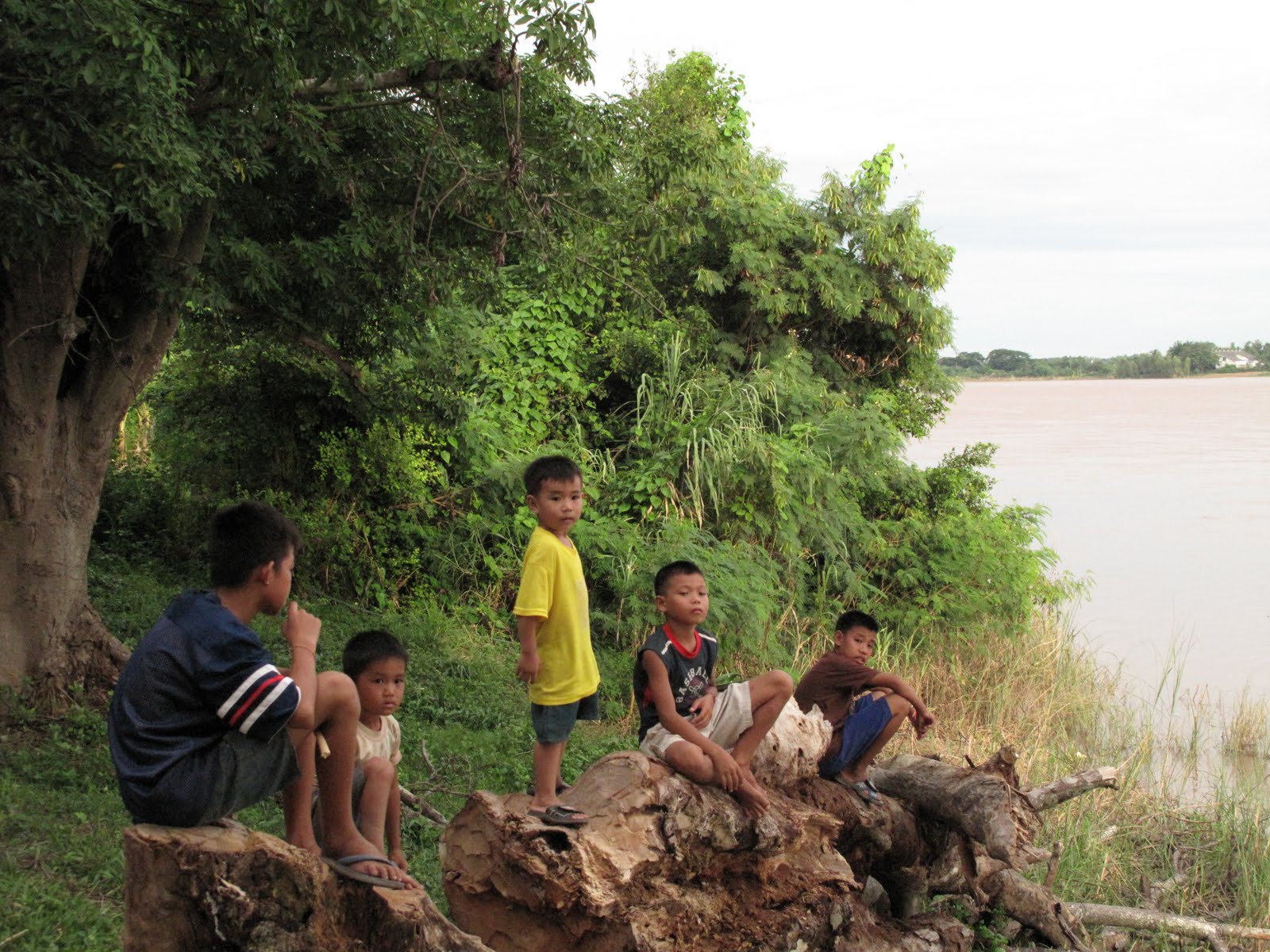
Buddhist lent is coming to an end, and that means boat racing here in Vientiane.  Teams are practicing rowing their brightly colored massive wooden hand-carved boats in preparation for the big day, next month.  I made my way out to a village where some friends were practicing to survey the scene.  On the shore, the whole village came out to watch the spectacle - foreign and Lao women rowing a big traditional boat up and down the Mekong.  Eating grilled river snail and canned Beer Lao, I tried to carry on conversations about the most simple things with the gaggles of village boys who showed up to the Saturday entertainment.  We had some laughs.


Also paid a visit to a funny relic called Buddha Park.  An hours drive from Vientiane in a small grass field next to the Mekong, there exists moss covered concrete giants. Images from Buddhism and Hinduism are scattered throughout the garden, with a strange onion shaped orb that can be ascended through a series of semi-functional stairwells inside.  Makes me consider that universal human desire to create - to extrude into possibility the chaotic free stuff of this world, mash it together into a semblance of a form, and aim it towards the cosmos. To erect such shadow-casting objects is to live on into the lives of those future humans who must, as they stand before the creation, wonder what was gyrating through the mind of the creator.


In the next month or so, Laos and the region will be transitioning into the cool, dry season. I am moving into a more permanent residence tomorrow with three other PiA fellows... a balcony-laden strangely partitioned abode in a nice Laos neighborhood. Time is picking up pace.  My being is no metronome these days, some days are months, some weeks are seconds. Just about (what I am told is) a month into my new life in Laos, and things make a bit more sense. Hope fall is upon you, but not literally.


Love, kyle.


Sunday, September 4, 2011

dual nature


Asia, Southeast Asia, Laos... a place rife with dualities and juxtapositions. Hallowed cultures, dating back to rice empires won and lost, colonial histories still trickling through the seams of society, and a governmental focus on developing to keep up with the demanding economies of the western world. These all happen in tandem, overlapping and intertwining to make a complex fabric of interactions that is easy to get wrapped up in.


Got myself a motorbike, the standard vehicle of the masses here, a 110cc Kolao. Independent mobility is a beautiful thing. Spent the weekend driving through the outskirts of town and countryside, talking to grandmas and children and whoever will speak slowly enough and forgive my terrible tone usage. Spent a day at a 'waterfall' which was more of a few enhanced rapids where Lao families sip Beer Lao and eat sticky rice while taking a dip.


In other news, I want to dedicate this thought to the life of Nell the dog, a truly significant part of the childhood of both Eli and I. I still remember those autumn afternoons running her through her worm-hole plastic tube in our backyard, and waltzing her around our kitchen floor, arm outstretched. She certainly got us through some hard dog-woe times, and in part inspired us to get one of our own. Watching her grow old reminded me of an old wise woman, who had shared with us some secrets about life that we would never have otherwise known.

Wednesday, August 31, 2011

sunday around town


to all my fellow onesie-wearers.... I've found our Asian brothren.


Saturday, August 27, 2011

week one


How does one make a leap? This first week I have spent in large part wondering that, wondering how such a shocking life change can occur in the bowels of an airplane, between tarmacs of burnt rubber, in a dazed stupor of flights and baggage and ticket windows and bad breath. How does massive change happen? How can the inertia of life-as-we-know-it business-as-usual be funneled down a new channel? Is the change preconceived and considered in its painful excruciating specific details? No, to make massive change we must idealize to some extent. We must trust in the positives, the benefits, we must forego incubating the anxieties and worries that plague any decision. We must, in the end, imagine ourselves into it.


It has been a challenging transition, to begin to try to make a life here in this land. The mekong runs high and muddy now, sunsets drool over the towering rain clouds upstream, vegetable and noodle stands insulate the corners of any intersection from the assortment of wheeled things... some more stable than others.


My first week of work proved both eciting and mundane, high and low. Major projects that WWF is focused on here included sustainable hydropower, carbon forest credits to prevent deforestation, and species conservation. The Mekong is remarkably productive - with millions of people relying on it for subsistence. Damns on the river jeopardize the ability of the numerous species of migrating fish to reproduce upstream, and then return downriver. The wet season dry season equilibrium is precisely atuned to these reproductive behaviors that have evolved over so many million years.

The idea of the western industrialized world outsourcing their conservation to the third world is abstract, indirect, and a bit suspicious. The fact is though, tons and tons of carbon are sequestered every year by the productive forest of the tropics. Keeping these intact is imperative for our future on this planet. Local people and their growing rural populations rely on these forests for their livelihood though - so figuring out a just system for allocating the wealth that could be gained by quantifying and selling the carbon credits stored in these Southeast Asian forests is a huge mind boggling project.

Things are getting easier here. Finding a house and mobility options. Remembering my thai language (which most people understand) and picking up the lao slowly. Hope you are well, miss you big time. -kyle


Monday, August 15, 2011

Laos bound


As I depart this country to live in a new tropical city, I leave you with some fitting words from Salman Rushdie's Satanic Verses (365-366). Gibreel, a son caught between the India of his birth and the England of his colonial heritage, imagines 'tropicalizing' a more western, higher latitude city - in this case London.

"Gibreel enumerated the benefits of the proposed metamorphosis of London into a tropical city: increased moral definition, institution of a national siesta, development of vidid and expansive patters of behaviour among the populace, higher-quality popular music, new birds in the trees (macaws, peacocks, cockatoos), new trees under the birds (coco-palms, tamarind, banyans with hanging beards). Improved street-life, outrageously coloured flowers (magenta, vermilion, neon-green), spider-monkeys in the oaks. A new mass market for domestic air-conditioning units, ceiling fans, anti-mosquito coils and sprays... higher emphasis on ball-control among professional footballers, the traditional and soulless English commitment to 'high workrate' having been rendered obsolete by the heat. Religious fervour, political ferment, renewal of interest in the intelligentsia. No more British reserve; hot-water bottles to be banished forever, replaced in the foetid nights by the making of slow and odorous love. Emergence of new social values: friends to commence dropping in on one another without making appointments, closure of old folks' homes, emphasis on the extended family. Spicier food; the use of water as well as paper in English toilets; the joy of running fully dressed through the first rains of the monsoon."

If this fits or not, we shall see. Will let you know as soon as possible.

-k


Friday, December 18, 2009

home, to home

life as a reef
less color, more gravity
how absurdly unfortunate
we live up here, with such relative lack and surplus
of these most pivotal phenomena
an inversion of such
proves both wildly inhospitable and miraculously stunning


fresh off the boat, i return to chiang mai for a final 48 hours. the last 3 weeks have been on a little archipelago 70 km off the coast of southern thailand near malaysia. The first half consisted of camping on the beach and kayaking between snorkeling sites - mooray eels, puffer and porcupine fish, sting rays, coral beds, sea snakes, anenome, starfish, urchins, nemo. Its quite a world down there, an intricate scaffold of coral filled with tiny zoozanthellae photosynthesizing at the lowest trophic level, followed up the latter by a diverse array of creatures who have their own coral reef niche. Amazing colors, absurd co-evolutionary adaptation, a place still hunted and gathered - the last true wildlife on earth the oceans are.

But its not all fun and games... the ocean acts like an absorbtive sponge respirating into and out of the atmosphere that we fill with CO2 among other things. The ocean absorbs the vast majority of our
carbon emissions - and is becoming less and less saturated with calcium carbonate as a result. This will cause problems for creatures that form shells and corals that cement calcium carbonate. Ocean acidification is really happening and will continue to occur into the future. Rising sea level temperature causes corals to release their symbiotic zoozanthellae friends causing bleaching. Unabated, life will still exist in the oceans, just not as we know it. Jellyfish may take over the world. But we could start eating them. They could be delicious hor'de'vores for future climate summits like in Copenhagen.
The Urak Lawoi people (people of the sea) have inhabited Koh Lipe, an island in the Adang Archipelago for almost a century. They traditionally relied on the reef for subsistence but have now turned to the tourist industry and small scale commercial fishing in the offseason. Things are not looking good for the local people - they are selling off or being pushed off their land by resorts, trash is piling up on the island, sewage is seeping into the groundwater threatening to leech into the reef causing an algal overgrowth, and the fishing isn't so good. Predator populations like the king mackeral and tuna are being overfished by both the Urak Lawoi and the huge Thai and Malaysian trawlers who pay the vastly underpaid national park officials to illegally fish within the park.

Darwin used the island ecosystem as a microcosm for a larger more complex ecosystem. We did the same with the situation on Koh Lipe. The island could foreshadow the island landmass of earth, also surrounded by ocean. The tragedy of the commons in full effect. Individual benefit of exploitation outweighs the collectively shared degredation. Individual altruism won't solve the problem - collective organization is needed but near impossible with the vast array of stakeholders on the island. Local people, national park, commercial trawlers, tourists, investors from the mainland, resorts, etc. The human being is only adapted to conceptualize at most maybe an 100 year time frame. Future generations have no vote. I personally was slightly upset with the past few generations... because of their treatment of the area sea turtles, dugongs (manatee like), sharks, big old fish - mainstays of a healthy coral reef, were missing. If development on Koh Lipe continues and commercial fishing keeps up the local people have no future in the area.

I am officially finished with half of my junior year!... now that I've returned from the beach island resorts, vacation is finally upon me. To the hinterlands I will go. Me and two accomplices are headed to Cambodia for a whirlwind 2 week odyssey. Merry new year, happy christmases, good solid kawanzas and belated joyous hannukahs, vuluptuous solstice moon times, live long and prosper my friends.... Odd days are upon us!